







Album Review: Essentials — Nick-All
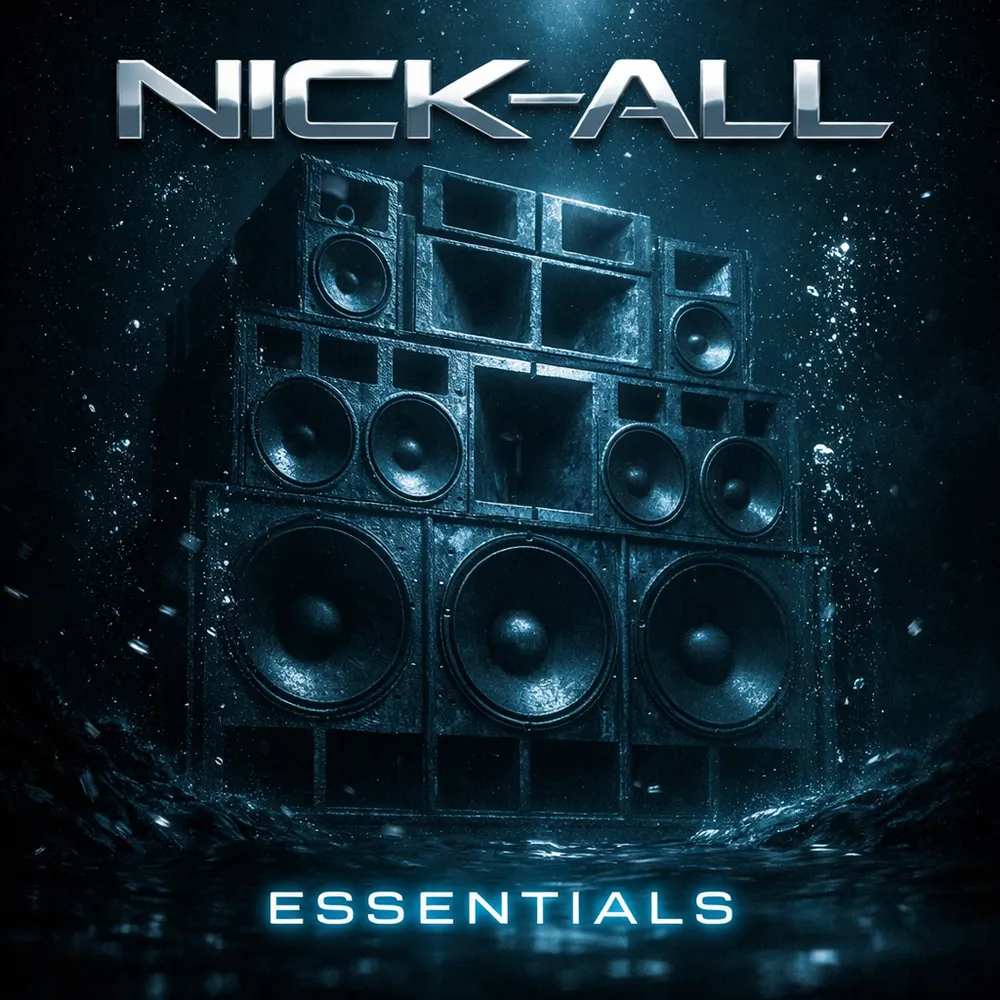
Album Review: Essentials — Nick-All
Released July 31st 2026
EDM / Drum n Bass
Album Review: Essentials — Nick-All
There is an interesting contradiction sitting at the heart of Nick-All’s third album. It is called Essentials, yet almost everything about the record seems determined to reject the idea that an electronic musician should be reduced to a set of essential characteristics. Is Nick-All a drum & bass producer? A DJ? A bassist? A house producer? An experimental electronic artist?
The answer offered by Essentials is refreshingly simple:
Why choose?
For the Belgian producer, DJ and electric bassist, the real essential appears to be freedom—freedom to move between styles, freedom to follow an idea wherever it leads and, perhaps most importantly, freedom to make electronic music that retains the fingerprints of the human being creating it.
That philosophy is particularly appropriate for an album collecting material from several years of Nick-All’s development alongside newer work. Rather than disguising those different periods, Essentials embraces them. It feels like a musical journal documenting an artist gradually discovering exactly what he wants his identity to be.
And increasingly, that identity revolves around bass.
Not merely bass as frequency, either.
Bass as an instrument.
Bass as rhythm.
Bass as culture.
Bass as something you physically feel.
Nick-All’s background as a trained electric bassist gives Essentials an unusual foundation. Electronic bass music is naturally obsessed with the low end, but programmed bass and played bass don’t always behave in quite the same way. A musician brings tiny variations in timing, emphasis and phrasing that can create a pocket difficult to reproduce through perfectly quantized programming.
That human pulse becomes one of the defining characteristics of the record.
Nick-All is operating primarily within drum & bass territory here, but Essentials isn’t particularly interested in behaving like a genre exercise. Roadie Music reached a similar conclusion, describing all twelve tracks as touched by experimentation and specifically noting the album’s ability to move between drum & bass and house while retaining a coherent identity.
That’s an important distinction.
This isn’t EDM assembled from a checklist.
It sounds like EDM made by someone who enjoys discovering what happens when the checklist gets thrown away.
The album’s harder DnB personality emerges particularly well on “Lost Knight.” There’s something darker and more introspective happening here, with atmosphere becoming as important as sheer rhythmic force. Roadie Music singled the track out for its hypnotic, almost ethereal character before noting how it progressively asserts its drum & bass identity. It’s a great example of Nick-All’s approach: instead of immediately revealing everything a track intends to do, he allows the environment to establish itself first.
“Away” works in similarly immersive territory, but the rhythmic attack is more pronounced. Hard pulses disturb the atmospheric surface while colder synthetic textures surround the beat. There’s a tension between wanting to disappear into the soundscape and being repeatedly pulled back onto the dance floor. That contrast is one of Essentials’ most enjoyable tricks. Roadie Music also picked up on the track’s immersive atmosphere, syncopation and colder electronic textures.
Then there is “Too Long,” which demonstrates just how comfortable Nick-All is stepping outside strict DnB boundaries. Low frequencies give it a dramatic foundation, but its rhythmic movement gradually suggests techno and eventually house. Rather than sounding like a producer trying several genres on for size, it feels like those styles are different rooms inside the same club.
And then somebody opens the door to the reggae room.
Because one of the album’s absolute highlights is “War (Nick-All DNB Remix),” Nick-All’s reworking of Ras Dave.
This is where the idea behind Essentials really clicks.
Reggae and drum & bass are hardly strangers. The relationship runs deep through jungle, soundsystem culture and the historical development of UK bass music. But Nick-All doesn’t treat the reggae vocal merely as decoration placed over a DnB beat. He rebuilds the song’s environment around it.
The result feels like Kingston soundsystem culture rewired for a European club at three in the morning.
Ras Dave’s vocal supplies weight and personality while Nick-All surrounds it with a much faster, more aggressive electronic framework. The collision works because the remix understands the rhythmic DNA shared by both musical traditions. The reggae character isn’t erased by the drum & bass production; instead, it becomes the anchor.
The remix originally arrived as a single on April 17, 2026 through Ten Fathoms Records before being incorporated into Essentials. Apple Music classifies that release specifically as Jungle/Drum’n’Bass.
It may be the clearest representation of Nick-All’s LOVE AND BASS mantra anywhere on the album.
Elsewhere, “Sting” demonstrates the more openly celebratory side of his music. Interestingly, Nick-All himself has identified “Sting” as particularly important, describing it on his Apple Music artist profile as a step forward in his career and a track into which he put everything he had.
You can understand why.
There’s confidence here.
Not arrogance—confidence.
The difference matters. Essentials sounds like the work of an artist becoming increasingly comfortable with the fact that his musical personality doesn’t need to fit neatly into one Beatport category.
“The Essential Is…” makes that philosophy explicit. Its atmospheric, ethereal introduction provides one of the album’s more reflective moments and gives the record’s title additional meaning. Roadie Music also identified it as one of the standout compositions, alongside “Sting,” “War,” “Lost Knight,” “Away” and “Too Long.”
And that title deserves attention.
The Essential Is…
Freedom.
That’s really the thread connecting everything.
It connects the heavy drum & bass passages to the house excursions. It connects the electronic production to the physicality of played bass. It connects introspective pieces to material designed for a packed club.
Even tracks such as “Here Come Duh,” “Addicted,” “Hold On,” “Far Away From U,” and the intriguingly titled “Elding Calcinatio” contribute to the feeling that Essentials isn’t attempting to freeze Nick-All at one particular moment in his career. Instead, the album functions almost like a snapshot taken over time.
That’s appropriate considering the project draws from his creative journey between 2020 and 2024 while incorporating newer material.
You can hear evolution rather than uniformity.
And that becomes one of the album’s greatest strengths.
In contemporary electronic music, where producers are often encouraged to identify an extremely specific niche and repeatedly feed it, there’s something refreshing about an album that effectively says, “This is what I wanted to make.”
Nick-All’s story also makes that independence feel believable rather than manufactured. Based in Liège, Belgium, he has emerged through that city’s electronic and club environment, and his Apple Music profile recalls receiving an unexpected invitation from a Liège student organization to perform at Unifestival—an opportunity he discovered simply because he happened to check his email that day.
There’s something wonderfully appropriate about that anecdote.
A career opportunity appears unexpectedly.
You follow it.
You keep producing.
You keep playing.
You keep evolving.
And eventually those years become Essentials.
Production-wise, the record understands something fundamental about drum & bass: speed alone doesn’t create energy. Space matters. Contrast matters. The anticipation before the impact matters.
The best moments here allow atmospheric sections enough room to develop that the rhythmic arrival actually means something. Synthesizers can be cold and metallic one moment, airy and introspective the next. Percussion can hammer forward aggressively before giving way to something considerably more restrained.
Most importantly, the low end remains musical.
That bassist’s mentality makes itself felt.
Rather than bass existing merely as the enormous frequency occupying everything below the kick drum, it often feels like part of the composition’s groove—the connective tissue between percussion and melody.
That’s what ultimately separates Essentials from being simply another collection of EDM tracks.
There’s a musician underneath the machinery.
Nick-All clearly understands the tools and conventions of contemporary electronic production, but he also understands the sensation of physically playing an instrument and finding the pocket with other musical elements.
That combination gives the album personality.
Essentials isn’t pristine because it has removed every trace of humanity.
It works because humanity remains inside it.
Across its twelve tracks, Nick-All moves through drum & bass, jump-up energy, house, techno-adjacent rhythms, reggae influence, atmospheric electronics and moments of genuine introspection without losing sight of the thing holding everything together.
LOVE AND BASS.
It may sound like a simple slogan, but after listening to Essentials, it begins to feel more like a mission statement.
Love the music.
Love the freedom.
And, whenever possible…
turn the bass up.
You can listen to the album here, on Spotify:


